PhemosReach / Content workflow guides
How to keep AI social posts in your brand voice
By PhemosReach, a Modus Future product · Published · Updated
“Professional and friendly” gives a writer little to act on. A useful voice brief shows what you mean, explains the choices and sets boundaries. Start with writing you have the right to use and would be comfortable publishing again.
This guide walks through choosing samples, turning tone words into instructions, a before-and-after example, a voice brief you can copy or download, the difference between voice and guidelines, adjusting by channel, and how to spot a draft that has drifted.
Choose representative samples
Pick a few passages that sound like your brand: an explanation, an announcement and a response to a common reader question. Remove private customer information. Avoid filling the brief with writing you dislike just because it performed well once.
Annotate each passage. Point out the sentence length, vocabulary, point of view and call to action you want to repeat. Name an exception too: a short launch announcement may be more energetic than a support explanation.
How many samples, and which ones
Coverage matters more than volume. Five passages that span your main formats teach more than twenty that are all product announcements. A good starting set:
- an explanation of something your readers find confusing
- an announcement of something new
- a reply to a real reader question, with personal details removed
- a short social post that did what you wanted it to
- a longer piece, such as a newsletter section, that shows how you build an argument
Leave out anything written by someone else in a voice you would not use, anything heavily edited by a committee, and anything you would be embarrassed to see copied.
In PhemosReach, a voice profile takes up to 5 writing samples on the Free and Starter plans, 10 on Pro and 20 on Business. Start with five good ones on any plan and add more only when drafts keep missing a particular format.
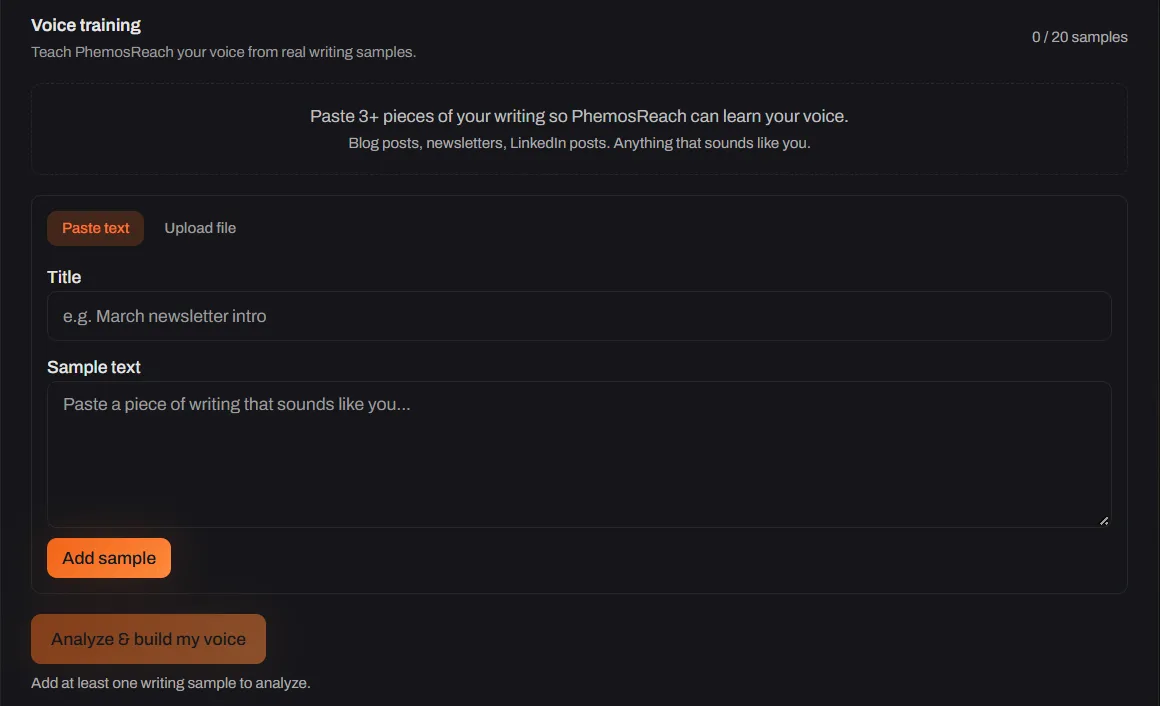
Voice training in PhemosReach, before any samples are added. Each sample is a real piece of your writing, pasted or uploaded.
Turn adjectives into instructions
- Instead of “clear”: name the action in the first sentence and explain unfamiliar terms.
- Instead of “confident”: state supported facts directly and mark uncertainty when evidence is missing.
- Instead of “human”: use words your readers use and remove stock introductions.
- Instead of “energetic”: use concrete verbs; do not add urgency to routine updates.
Write down the words you never use
A list of banned words and phrases does more for consistency than any adjective. It is easy to check, easy to share and hard to misread. Include:
- the stock openers you are tired of, such as “In today's fast-paced world”
- the hype words you cannot back up, such as “revolutionary”, “effortless” or “game-changing”
- claims you are not allowed to make, such as guarantees or results you have not measured
- punctuation habits you dislike, such as rows of exclamation marks or emoji in every line
When a draft uses one, you do not need a debate about tone. The word comes out.
Before and after, with editing rationale
This is an illustrative writing exercise, not customer copy or a measured AI result.
Before: “Unlock unparalleled engagement with our revolutionary content solution.”
After: “Bring one useful idea. Shape the draft in your voice. Review it before it goes out.”
The revision replaces an unsupported result with three visible actions. The short sentences suit an introductory social post. For a detailed tutorial, keep the same direct language but add the steps a reader needs; brand voice does not require every format to have the same length.
Copy this voice brief
Reader:
What the reader needs from this post:
Representative passage:
Why it sounds like us:
Preferred words and sentence patterns:
Words and claims to avoid:
Tone exceptions by format:
Evidence for this post's claims:
Desired next step:
Download the voice brief as a text file. Fill in one brief for the brand, then a shorter copy for each format that behaves differently.
Voice and guidelines are different checks
Your voice is how you sound. Your guidelines are what you are allowed to say. A draft can be perfectly on voice and still claim something you cannot support, name a competitor you have agreed not to mention, or promise a result you have not measured.
Keep them as two lists and check both. PhemosReach keeps them separate too: your voice profile shapes the draft, and each draft is checked against your brand guidelines before it reaches you.
Adjust by channel, not by personality
One brand, one voice, different delivery. The same writer can be brief on X, more explanatory on LinkedIn and more relaxed in a TikTok caption without becoming a different person.
Write the channel differences as rules rather than moods: maximum sentence length, whether hashtags are used and how many, whether the post opens with a question, how the call to action is phrased. Rules are easy to check; “a bit more fun on Instagram” is not. From the Pro plan, PhemosReach can give each channel its own persona, so each channel's rules sit with its own profile.
Give the brief to everyone who writes
A brief that lives in one person's head is not a brief. Share it with anyone who drafts for the brand: a colleague covering leave, a freelancer, an agency, and the AI tool you draft with. Each of them should get the same five samples, the same banned list and the same channel rules.
When a freelancer's draft comes back off voice, check the brief before you rewrite the draft. If the brief did not say it, the writer could not have known it, and the fix belongs in the brief.
Signs a draft has drifted
AI drafts tend to drift in the same few ways. Watch for:
- Stock openers. “Are you struggling with...” or “In a world where...” Cut the first sentence and see if the post is better without it. It usually is.
- Borrowed enthusiasm. Exclamation marks and superlatives that your samples never use.
- Hedging everywhere. “May help to potentially improve” where your voice would state a supported fact plainly.
- Generic examples. A made-up business in place of the specific situation your readers are in.
- The wrong length. A three-paragraph post where your samples say two sentences.
When you see the same drift twice, do not just fix the draft. Add the fix to the brief as an instruction or a banned phrase, so the next draft starts closer.
Build the brief in an hour
A voice brief does not need a workshop. One focused hour gets you a version good enough to start drafting with, and the monthly review improves it from there.
- Gather (10 minutes). Pull ten pieces of writing you would happily publish again. Do not judge them yet.
- Choose (10 minutes). Keep the five that cover the most formats, using the starting set above. Put the rest aside as possible later samples.
- Annotate (15 minutes). For each sample, write one line on what makes it sound like you: the sentence length, a word you always use, how it ends.
- Ban (10 minutes). List the words, openers and claims you never want to see. Start with the last three things you cut from a draft.
- Write the brief (10 minutes). Fill in the template above, using your annotations as the preferred patterns and your ban list as the words to avoid.
- Test (5 minutes). Draft one real post against the brief and compare it with your best sample. Note the biggest difference; that is next month's first change.
The first version will be incomplete. That is fine. A short brief that gets used beats a thorough one that nobody opens.
Review meaning before polishing tone
First check that the draft is correct and useful. Then remove phrases you would never say, replace vague claims and compare the result with a sample. A fluent sentence can still be false. Voice instructions guide drafting; they do not verify facts or guarantee consistency.
Review the voice once a month
Once a month, read the last ten posts that went out, side by side. Look for the edits you keep making, the phrases that keep coming back and the formats that never quite land. Each of those is an instruction or a sample missing from the brief.
Change one thing at a time. If you rewrite the whole brief at once, you will not know which change helped.
Keep a short log beside the brief: the date, the one instruction you changed, and what you expected it to fix. After three or four months the log tells you which kinds of instruction work for your brand and which ones the drafts ignore. It also stops the brief from quietly growing into a list of rules nobody remembers adding. If an instruction has not changed a draft in two months, it can probably go.
Use the brief in PhemosReach
Keep voice instructions and representative writing samples in your voice profile. Review a proposed profile before adopting it, then check the generated draft against your source and intended reader. When you change an instruction, try it on the same example so the difference is easy to assess.
Carry the result through the message and finished-post review checklist. For a recurring routine, see the small-team content workflow.
Questions
How many writing samples does an AI need to learn a brand voice?
Fewer than most people expect, if they are the right ones. Five well-chosen passages that cover an explanation, an announcement and a reply to a reader teach more than twenty that all sound the same.
Add samples when drafts keep missing a particular format, not to reach a number.
Should each social platform have a different brand voice?
Keep one voice and adjust the delivery. The same brand can be brief on X, more explanatory on LinkedIn and more casual in a TikTok caption without becoming a different speaker.
Write the differences down as rules, such as sentence length and whether to use hashtags, rather than as separate personalities.
Can AI keep a brand voice consistent on its own?
It can get close with good instructions and representative samples, but it cannot verify facts or judge when a post is off. Someone still needs to read each draft before it goes out.
Treat the voice brief as a way to make first drafts closer to finished, not as a replacement for review.
What is the difference between a brand voice guide and brand guidelines?
A voice guide describes how you sound: sentence length, word choice, point of view. Brand guidelines describe what you may say: claims you can support, words you never use, topics you avoid.
A draft can be perfectly on voice and still break a guideline, so check both.
How often should you update a brand voice brief?
Review it once a month against the last ten posts that went out. If you keep making the same edit to drafts, that edit belongs in the brief.
Change one instruction at a time and test it on the same example, so you know which change made the difference.
Related guides
- Review a social post before publishing. A two-stage checklist, an example of a corrected claim and a copyable handoff template.
- Social media approval checklist. Twenty-four checks across four stages, a five-check short version for routine posts, and text and spreadsheet downloads.
- Schedule LinkedIn posts with an approval step. LinkedIn's own limits, a six-step routine from brief to published post, and the checks that catch the wrong page or the wrong audience.
- Schedule Instagram posts with an approval step. The limits scheduling tools work within, a six-step routine from brief to published post, and the checks that catch a bad crop or a missing image.